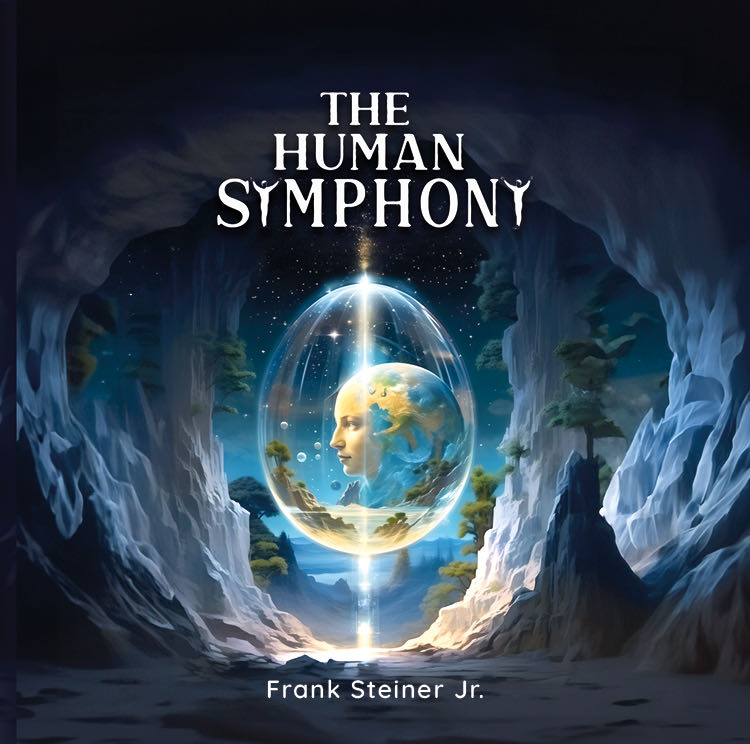
The Human Symphony
Join me on a unique musical journey!
This symphony is an impressive story of a journey through life, from birth to the afterlife.
Stylistically versatile, the compositions combine classical, rock and pop passages as well as folkloristic and world music elements.
As soon as one immerses oneself in the moving compositions, the mind paints vivid pictures - of the beauty and existence of human life in all its facets.
A fantastic journey, masterfully told in the universal and unique language of music. A captivating, emotional sound journey.
album reviews
How many Frank Steiner Jr. albums does a person need?
All of them! On his latest and now 6th solo album, the thoroughbred musician, who was born in Freiburg i.Br. and has been working as a composer, arranger and producer for over three decades, shows the complete range of his outstanding skills and surpasses himself in the process. First-class music is on offer from the first to the last minute.
The ‘Human Symphony’ is a project that Frank Steiner Jr. has been pursuing for a long time and is now presented like a mature, fine champagne. Wonderfully sparkling with intense and multi-faceted notes, yet with a lasting elegance.
Needless to say, every single one of Steiner's works is, without exception, top-class instrumental music, each characterised by his unmistakable musical signature, which always contains that ‘certain something’ that is difficult to put into words. Anyone who previously considered the debut album ‘I Ching Symphony’, released in 1998, to be the ultimate in Steiner's oeuvre could possibly change their mind. Because despite all the appreciation he has shown for his invariably excellent previous albums, ‘Human Symphony’ is, to put it mildly, the absolute bravura piece by this exceptional artist and can no longer be surpassed.
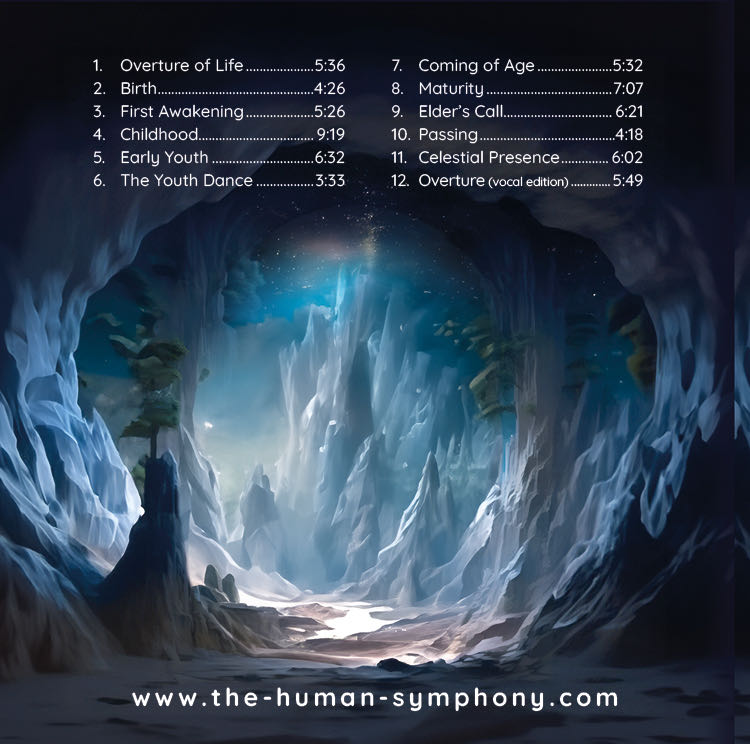
Steiner's latest work, rightly labelled Symphony, is probably best described as a concept album, designed as a fantastic musical journey through the individual phases of human life from birth to death with all its ups and downs. The music that we are presented with here spans an extremely skilful and very sensitive arc over the different stages that every person goes through during their life. The 11 phases of life set to music each have their own individual musical character, surrounded by the corresponding soundscapes that reflect the course of life and still leave enough room for interpretation for every listener. An incomparable and extraordinary musical experience of a special kind!
Wonderful melodies and legendary arrangements as well as distinctive and sometimes archaic rhythms await the audience. In addition, there is the use of classical, folkloristic and ethnic sounds and stylistic elements and a special knack for mixing electronic sounds with orchestral and acoustic arrangements. All of this makes ‘Human Symphony’ a true sound epic that should definitely be performed live on stage one day! Music that flatters the ears and also has plenty of emotional depth and complexity. Steiner's affinity for film music and folklore is well known among his connoisseurs. The sounds and melodies he creates here are breathtaking and truly great cinema! You could also describe the ‘Human Symphony’ as a ‘soundtrack of life’, so to speak, which comes across as absolutely Oscar-worthy after the first listen. In terms of composition, Steiner is at the zenith of his career and on a par with the great masters of film music such as Vangelis, John Williams, Hans Zimmer or Andrew Lloyd Webber. At the same time, he always keeps his very own unmistakable and charismatic style in mind. The production of the work is also first-class and the listener is literally pressed into the seats of their own head cinema. The most diverse emotions are evoked and intensified.
You experience a stylistically wide range from colossal thunderstorms of sound to danceable, pop-rock and sometimes musical elements, which skilfully alternate with quieter, subtly spherical and ballad-like melodies and sounds, harmonising beautifully with each other. The whole thing is accompanied and underscored in places by impressive choral passages and unique, sometimes mystical-sounding female voices.
The particularly outstanding pieces on this CD include the fantastically beautiful ‘Overture of Life’, the brilliantly rousing ‘Birth’, the slightly playful and cheerful ‘Childhood’, the breathtaking ‘Early Youth’ with its dynamic rock arrangements in some passages, the extremely hymn-like and powerful ‘Coming of Age’ and the rather transcendent and meditative ‘Celestial Presence’ at the end of the work.
There are certainly many more words of praise to be said about ‘Human Symphony’, but it is rightly said that ‘music is worth a thousand words’ and so... Take this fabulous musical jewel home and enjoy it from start to finish! Music at its finest, which literally inspires; music for eternity, which in a figurative sense is ‘born to live’ and at the same time ‘beautiful to die for’...
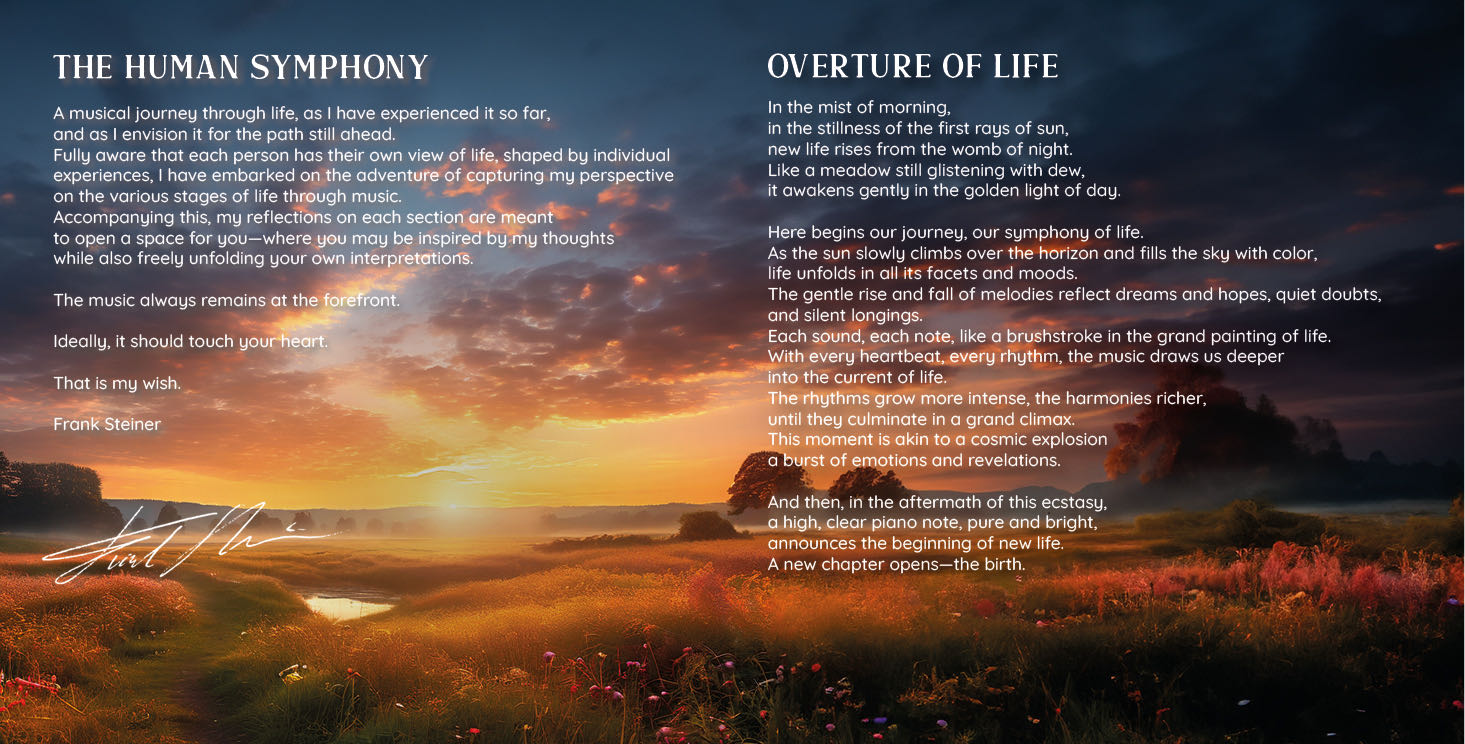
OVERTURE OF LIVE
The ‘Human Symphony’ is the quintessence of a musical journey through the phases of human life. It is not just a concept album, but rather a complete and multi-layered musical cycle from (before) birth to death (and the uncertainty afterwards). The adventurous journey begins with the brilliant opener ‘Overture of Live’.
Steiner opens the suspenseful arc of his work with a slowly increasing intro, initially very airy and cheerfully arranged but soon the strings set a slightly threatening tone. However, the fanfare-like solo trumpet and the almost elegiac piano steps that follow, as well as the oboe that enters, capture the tenor of the overture in its romantic and extremely striking refrain. An undulating, at times slightly dreamy melody that consistently gains momentum and takes on a march-like character. Instead of repeating the refrain again and again, an extremely original intermezzo follows, in which stylistic influences of the musical flash out in a staccato-like manner, combined with catchy brass sections. Following on from this, the listener is surrounded by romantic classical echoes à la Chopin, among other things, before the hymn-like refrain comes into play again in the further course - now interpreted by a mysterious ancient Chinese plucked instrument (guzheng), which is able to ‘touch the heavens, the spirits and the gods’ with its enchanting sound.
[Hou Jin, musician from the Han dynasty].
The whole thing intensifies rapidly towards the end: it becomes even more magnificent and pompous and ends almost bombastically in a musical firework display with absolute goosebumps. Nevertheless, Steiner manages to transition to the next track on the album in an almost playful and gently sparkling manner. What a debut!
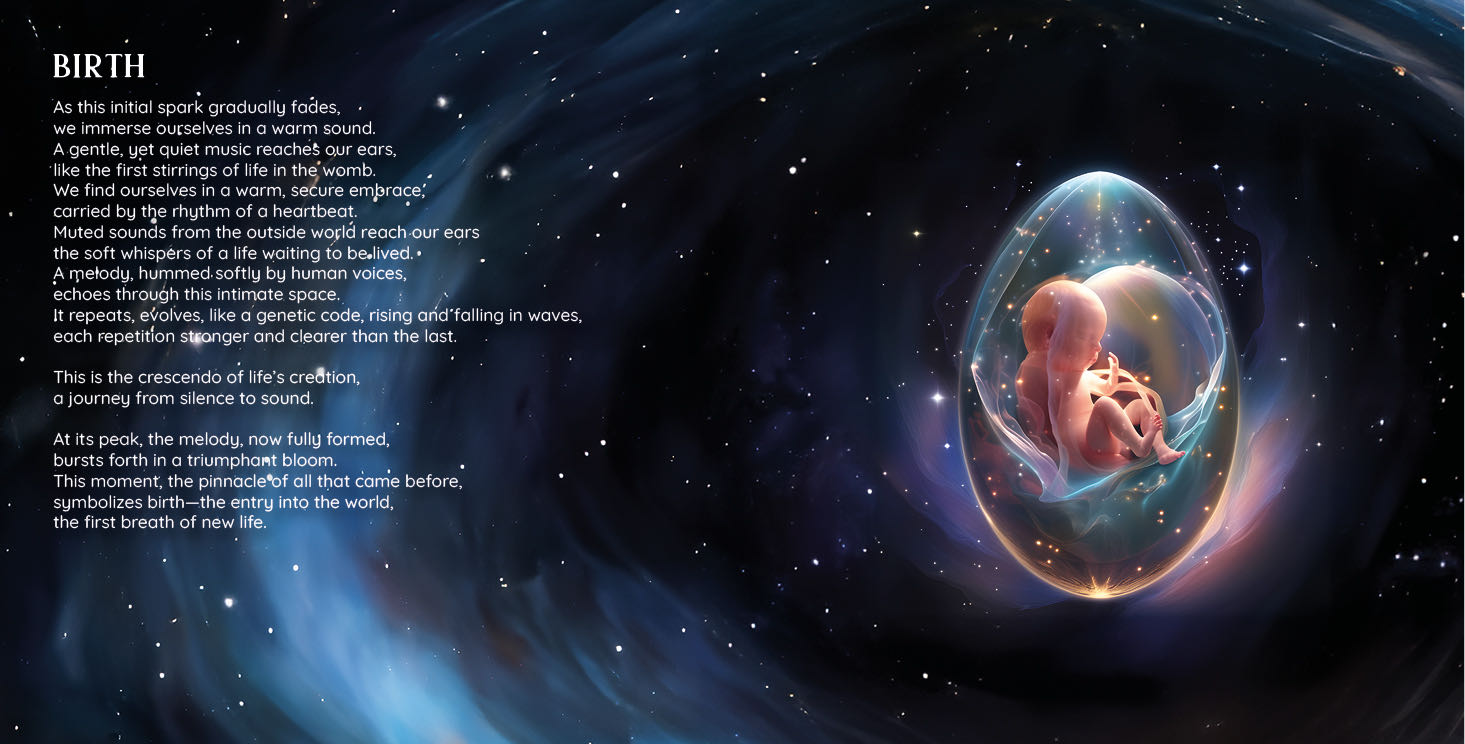
BIRTH
After the varied opener ended brilliantly, ‘Birth’ continues in a somewhat calmer vein.
The second track starts with a concise opening impulse in the form of a slowly fading piano note and further elegant and sonorous piano elements, accompanied by a mystical murmur and the pulsating heartbeat of the unborn child. Muffled external noises audible from the womb reach the ear.
The dynamics gradually increase; an intense build-up of tension announces that the birth is imminent. Striking wind and organ sounds solemnly announce the final breakthrough - the birth is complete!
A subsequent, almost casual finale with dreamy piano and the thunder of a weakening thunderstorm emphasise the completion of the birth and the arrival of the child on earth.
Welcome to earth!
FIRST AWAKENING
The listener is offered far more dignified sounds in ‘First Awakening’, which lives from its repetitive motif and begins the first awakening of the newborn in an almost festive manner with a bright and radiant trumpet intro that opens the round dance.
The piece is characterised above all by the alternating wind and string passages (trumpet and violin), which in their combination seem like a strongly interrelated, constantly complementary pair of opposites, driven by the common goal of protecting the newborn and gently acclimatising it. This is accompanied by uplifting classical sounds with fusions of instruments such as harp and glockenspiel and, after about 3 minutes of playing time, wonderfully complemented by ethereally sung lines in the background, which then quickly fade away again. The adagio-like, slow and at times almost wistful elements in ‘First Awakening’ make it seem extremely aesthetic and dignified right to the end. Listening to music like this makes you feel safe and secure.
CHILDHOOD
At over 9 minutes, the longest song on the work begins with the cheerful, exuberant ‘gurgling’ of children, a cheeky flute and a lively melody. Beautiful piano elements ripple along carefree like a spring stream and reinforce the childlike, playful lightness of the piece. After just over two minutes of playing time, the opening notes of a very warm and round-sounding acoustic guitar allow the song to breathe, take on additional form and gradually expand in its dynamics. As ‘Childhood’ progresses, Steiner once again proves himself to be a melodic genius, skilfully merging symphonic, classical and sometimes almost pop-rock soundscapes (including xylophone, wind instruments and piano) into an acoustic oeuvre - without ever abandoning his central theme. In part, there are also lively associations with film music. The song then experiences a truly ‘dreamlike’ interruption after a little over 5 minutes by putting the child into a gentle sleep with the beginning melody of a glockenspiel and a soft humming, while it processes what it has experienced so far in peace. At the end, the circle closes to the opening part, in which the dynamics increase again and the opening theme is repeated: A new, eventful day is already announced musically, arousing curiosity for the following pieces.
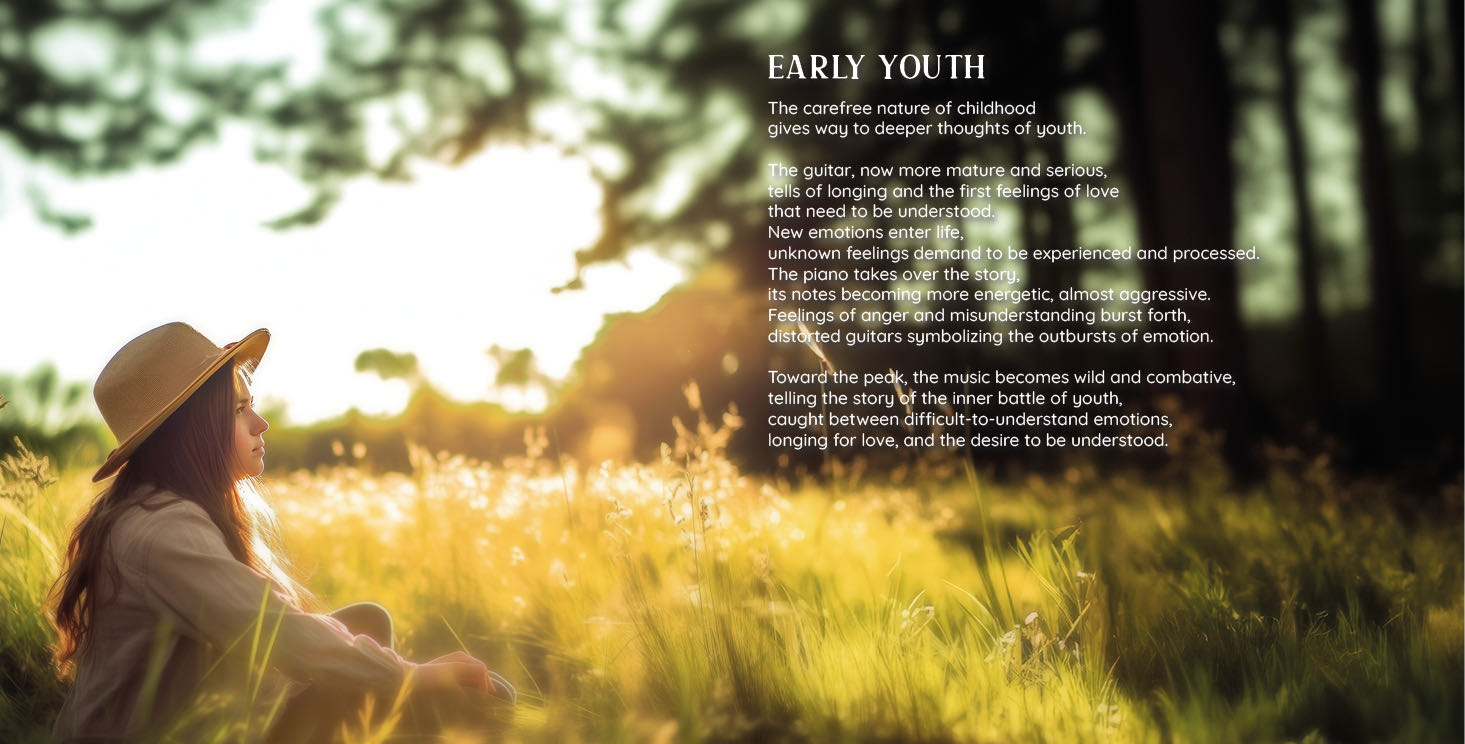
EARLY YOUTH
The playful ‘Childhood’ is followed by an exciting excursion into the six-and-a-half-minute ‘Early Youth’, which begins very solemnly and ends in an instrumental ‘tour de force’.
The warm-sounding acoustic guitar accompanied by a harmonious glockenspiel like something out of Mozart's Magic Flute and the perfectly sparkling piano chords and gentle string melodies already form a very varied introduction.
There is no shortage of variety in the further course of this ‘symphonic sound delicacy’: the heart-warming tones of a male voice with carefully arranged sound effect interludes are framed by deep wind instruments with an epic character and allow the listener to float off into the distance. Steiner elicits rich chords and sparkling tones from the piano, which may have felt touched in its soul. The partly mystical and legendary electric guitar sound stands out in particular, refined by a melodic guitar solo par excellence, which drives the already suspenseful piece even further forward.
Overall, ‘Early-Youth’ reveals a very broad spectrum of stylistic influences such as film music or rock music. The dynamic horns, for example, would have fitted in well with a fast-paced chase scene in an action film. A play with unusual sounds and tones that you should definitely experience live at a concert!
A piece that illustrates the dreams and aspirations of youth, as well as its spirit of optimism and the unknown. The majestic choral passages used at the end of the piece with their mysterious undertone also hint at something ominous in the form of impending threats and dangers that must be overcome in the further course of life. Despite this, the piece ends almost seamlessly - full of courage and confidence - in the cheerfully upbeat ‘Youth Dance’.
YOUTH-DANCE
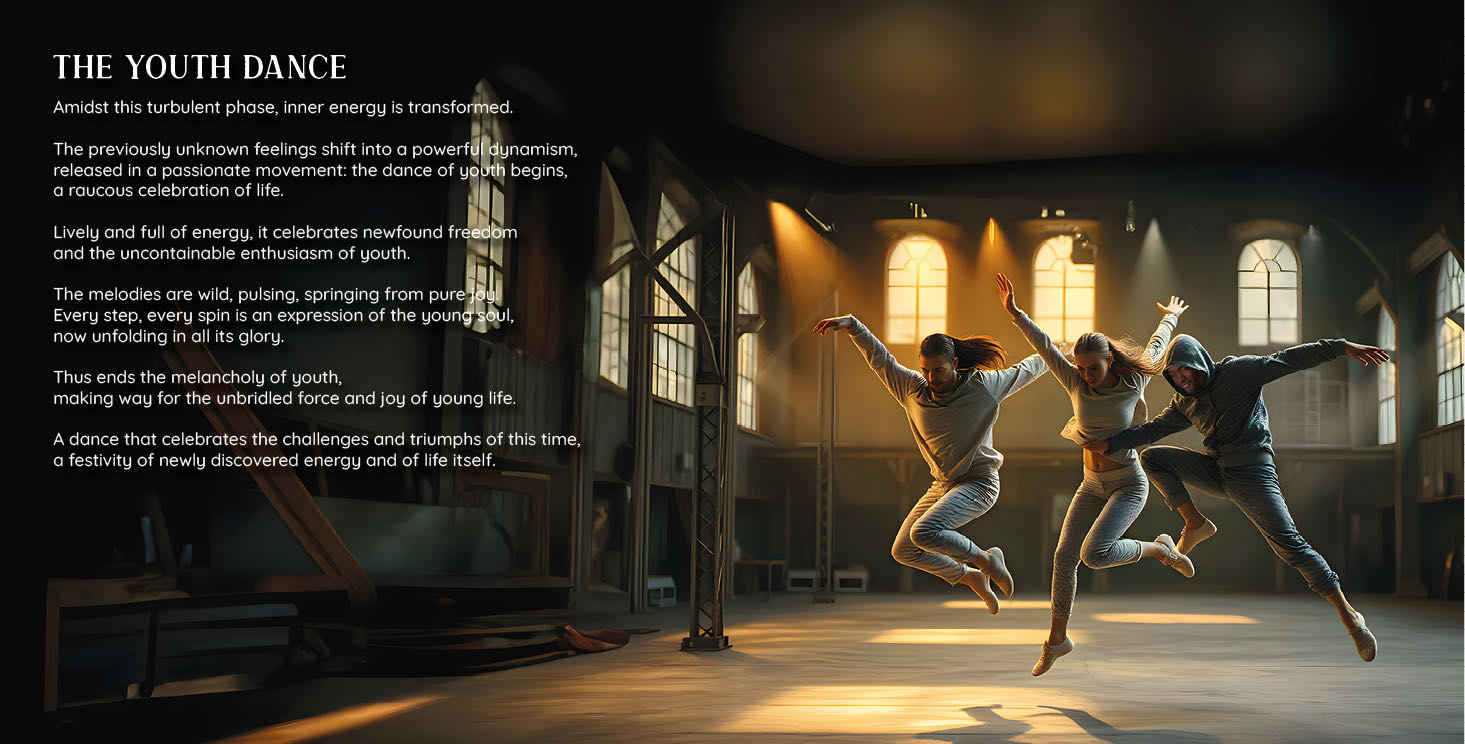
With a playing time of just under 4 minutes, ‘Youth-Dance’ is the shortest and probably most compact song on the album and is characterised by a lively violin (fiddle) right at the beginning.
Musically, a whole dance ensemble is gradually brought together here, which is ready to give a great performance right from the start and which succeeds without a doubt. The accordion song that starts later and plays for dancing is synonymous with the awakening of youth and Steiner gradually organises a veritable ‘folk firework display’. The same applies to the almost hypnotic attraction of the rhythms used. This is drama, excitement and passion all rolled into one; if you don't dance along now, it's your own fault! The lively dance of youth ends meaningfully in a unique and characteristic transition to the next piece, with the ethnic sound effects used here and the fascinating range of the mystical-archaic female voice that can be heard here topping it all off.
COMIMG OF AGE
‘Coming Of Age’ could confidently be described as the “centrepiece” of the entire work, as the album composition probably finds one of its greatest highlights in this monumental anthem, which undoubtedly stands for growing up and for people who are in the middle of life. The music is brilliant, radiant and at times also full of tension. A catchy tune that is bursting with monumental character and recognisability! The music sounds correspondingly imposing and majestic. You can't help but daydream, lose all sense of time and space and can even completely relax and drift away. Epic synthesisers, expressive low winds, string elements and renewed ‘embraces’ of archaic vocals really do allow you to immerse yourself in a ‘sea of music’. A real musical odyssey in the form of a ‘sound adventure’. Anyone who composes such an anthemic climax deserves all the honour!
MATURITY
‘Maturity’ begins with a floating soundscape, triggered by the slightly shamanic, dark male vocals used in the background, which are deliberately contrasted with the singing of a female voice as bright as a bell. Echoing piano sounds form the transition and dominate the main part of the piece, which is then replaced by bass clarinet, steel drums, tubular bells, glockenspiel and impressive wind instruments. The marimba in particular emphasises the symphonic character of the piece and towards the end Steiner brings the song to a shaman-like close, just as he began it. With dreamy piano and perfectly arranged funky-jazzy electric bass, this extremely multi-faceted song comes to a very elegant, almost casual conclusion.
ELDERS CALL
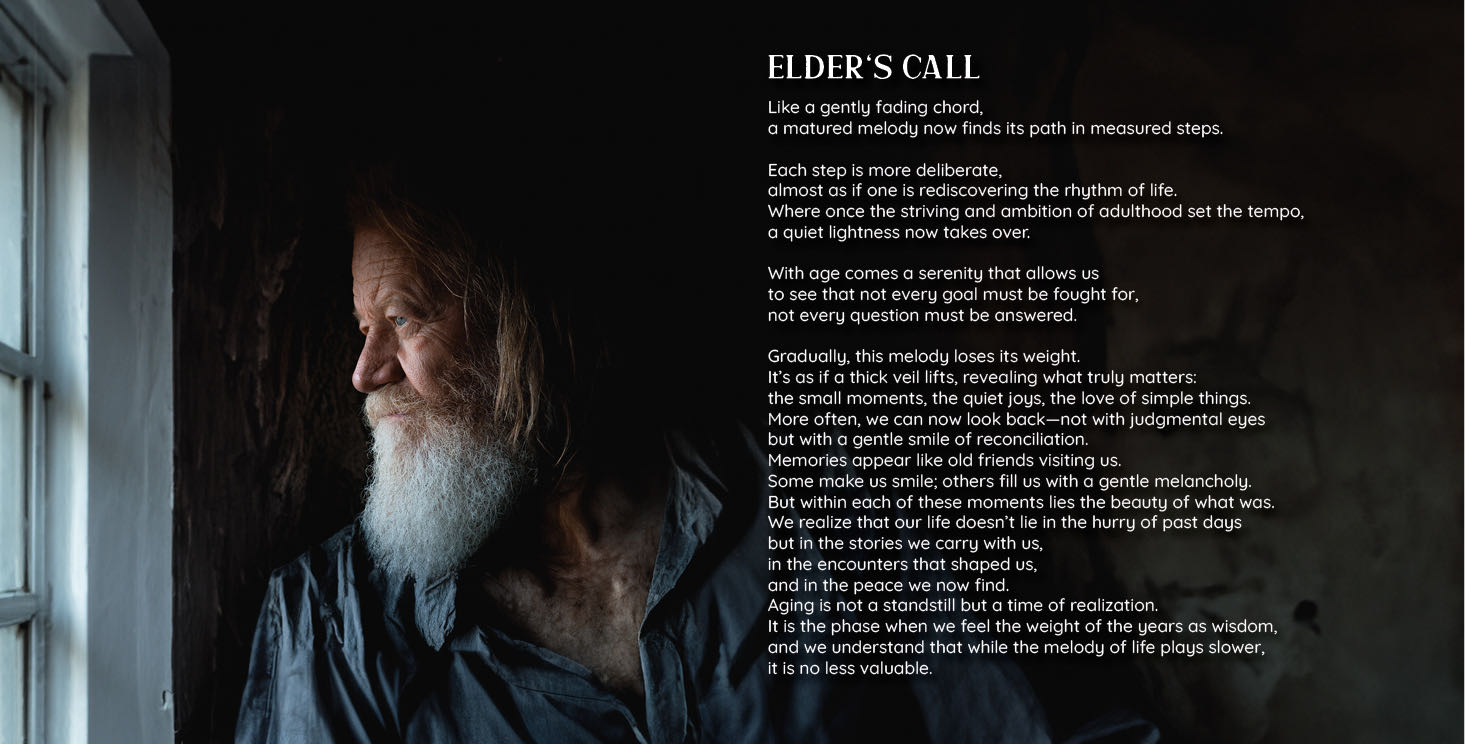
The transition to ‘Elders Call’ is seamless as the piano and the sustained string elements are simply continued. Music written for pausing and looking back.
Musically, the themes of wisdom in old age and dealing with the remaining time are reflected here. But it is also the bitter realisation, cast in sound, that life can be (too) short. While it sometimes sounds like a full orchestra with strings and wind instruments, the prominent sound object here is always the sparkling piano. At times, a clarinet or oboe accompanies the touching piece. Later, an acoustic guitar joins the piano solo. At the end of the song, the main theme from ‘First Awakening’ is taken up once again, bringing an album of high-calibre music and a heavy message full circle in a beautiful reminder of the first awakening.
A musical interplay of intention and a great, great sense of rhythm!
DEATH
‘Till death do us part’ ...What a pity, everything must come to an end, even this brilliant piece of music. The grand finale of the ‘Human Symphony’ is extremely dramatic and ‘Death’ proves to be one of the most intense climaxes of the entire work, capable of arousing a wide range of emotions in the listener. It is a sublime piece, characterised by imposing choirs and atmospheric strings, which vividly sets the end of life to music. A warm and at the same time melancholy oboe touches the listener's soul with a silvery lustre and makes it clear that the end is near. The swirling strings and winds that begin convey a sense of unease. As the piece progresses, the whole thing intensifies, interrupted by the clear, resonant sound of a vibraphone, into an intermediate section until it plummets into rumbling depths. In the course of this, the piece picks up speed once again, especially in its monumentality, and shows its ‘dark side’ in particular, in which, after a majestic choral passage, it leads into a refrain that is partly reminiscent of the musical ‘The Phantom of the Opera’ but also of Mozart's Requiem (‘Dies Irae’). The powerful, archaic choral passages and the extremely dynamic orchestration are then significantly reduced and the fade-out effect that sets in emphasises the fading of all the ‘noise of life’ shortly before death, right up to the last breath.
After a short playing time, the song comes to an absolute standstill...
CELESTIAL PRESENCE
To conclude his work, Steiner pushes the tombstone from the chamber of the dead and spreads an almost ethereal, meditative atmosphere of infinity with spherical 80s sounds on the keyboards, which ebbs away into cosmic space - everything floats, everything glides effortlessly into one another.... Steiner underpins the opening expanses of space with ‘Celestial Presence’, an atmospheric masterpiece. The record begins as strongly as it ends and Steiner tears open both the cloud cover and the gates to the heavens musically one last time.
OVERTURE (VOCAL EDITION)
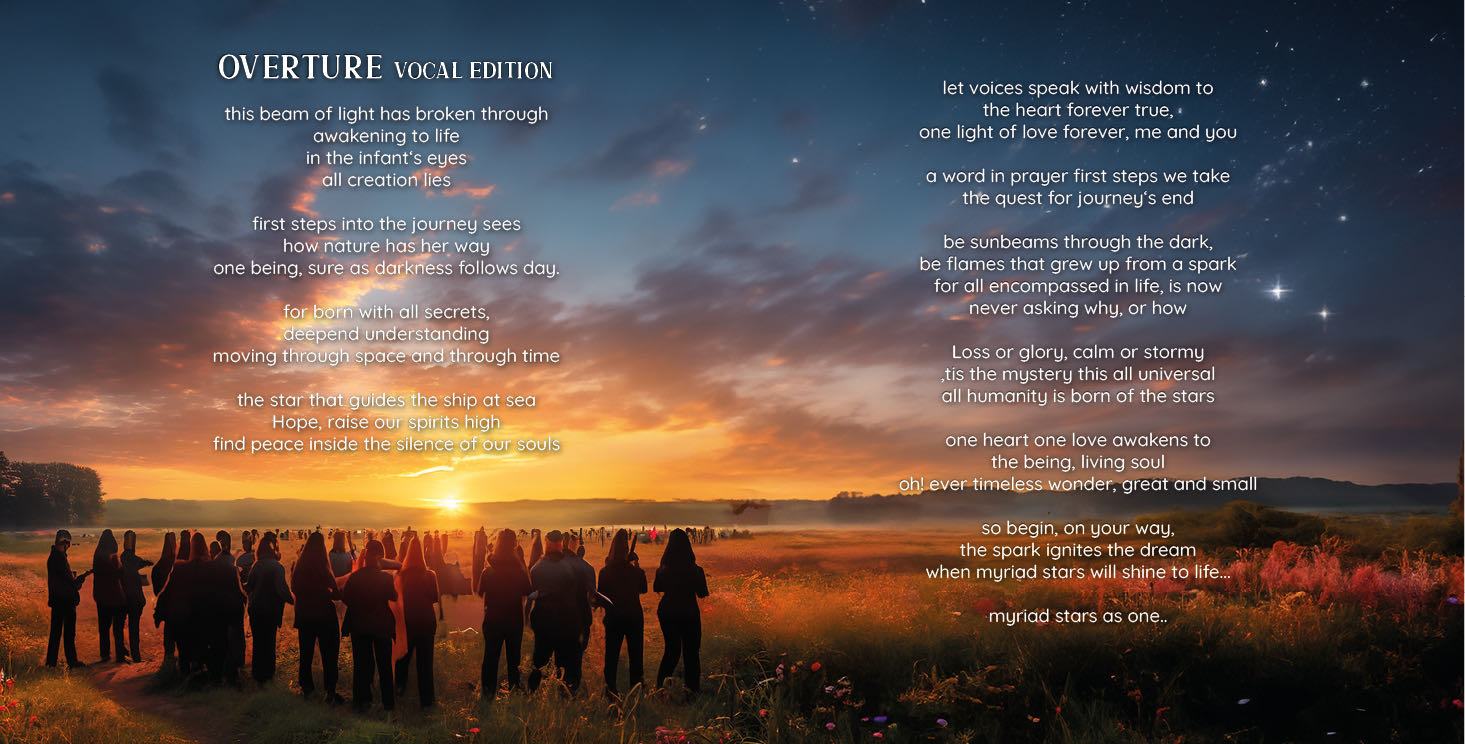
In the additional vocal edition of ‘Overture’, Frank Steiner jr. manages to skilfully and with equal concentration to span the narrative framework (of the otherwise instrumental longplayer) in just a single piece with lyrics. Starting with elegiac piano steps, strings and an opening line that could be an entire poem (‘this beam of light has broken through / awakening to life /in the infant's eyes /all creation lies’), a veritable ‘storm of a song’ is brewing - now significantly intensified by the impressive lyrics and vocals compared to the instrumental version. With an extremely original bridge ‘Loss or glory, calm or stormy / “tis the mystery this all universal / all humanity is born of the stars”, the track ends with an inviting message: ’so begin, on your way / the spark ignites the dream / when myriad stars will shine to life... / myriad stars as one...’ The lyrics by Shane Brady (‘Autumn light’) and the wonderful vocals by Stephanie Maria (album: ‘Infinity’) and others, in which she combines emotional depth with a magnificent voice, are really outstandingly good and whet the appetite for more compositions by Frank Steiner jr. with lyrics and vocals!
Frank Steiner's ‘Human Symphony’ can hardly be described in words. You have to experience it. Frank Steiner has mastered all the feelings and emotions that I experience while listening to it and reviewing the different phases of my own life in his realisation of the versatile musical keyboard. Reading the accompanying texts from the beautifully designed booklet while enjoying the respective pieces is indeed a must. Quite simply because it can bring back many memories. Grandiose is a word that at least comes close to describing it.
The composition of the album ‘The Human Symphony’ is noticeably a typical musical art of Frank Steiner jr.
It has something consistent and recognisable about it, which provides a supporting background that is a typically fascinating Frank Steiner sound.
And yet each album is always new and surprising in itself. The many facets of Frank's music only become apparent after listening to it many times.
Frank's music and especially the album ‘The Human Symphony’ invite you to open yourself up to it with all your senses in order to feel it.
Because Frank produces music that can and wants to be felt.
You can listen to the album without any worries, without picking up the booklet, surrender to it and let creations arise in you and come to realise what life is all about, what secrets and experiences it contains
However, when I pick up the booklet and listen to the music, I realise that Frank knows how to create a melody of life that speaks of a depth that meaningfully touches deep layers of the heart, because the words express how these compositions see the world with philosophical eyes. So I was able to go deep into words and the symphony of my human life itself. Ultimately, the album expresses the being of a whole life much more deeply than words can. Reading the booklet and letting it work, I feel a tenderness that springs from a heart that has experienced the growth of a child. All the facets of a person's developing life and development are expressed. Beginning with the development of a baby, the mostly still lively childhood and the urge and storm phase of adolescence and, after a short break, leading into the challenges of adulthood.
Death, which is all too often hushed up, and what we might face afterwards is also expressed in a touching way. What appeals to me is that Frank leaves it open as to what exactly will be in store for us. Because we don't really know. We can only trust those who have already been on the ‘other side’ through near-death experiences
The title ‘Celestial Presence’ and the photo in the booklet evoke in me the association of a deceased person wondering where the journey is going and where he is at the moment, in order to then trustingly surrender to what is there. What is impressive is the openness, in my opinion a grounded ‘unintentional spirituality’ in the work as a whole, which does not set any guidelines that could become dogma.
The artistic images in the booklet speak a mystical language that brings the inner feeling into a very personal vibration, without specifying where the individual's journey will take them. In this way, everyone can feel uplifted and accepted to face becoming and being human, right up to the physical end, with confidence. Life and death can be understood as a mystical experience that should not be met with fear, but with the love that life and death deserve.
‘The Human Symphony’ enables everyone to find themselves in their own life passages with their challenges, experiences and themes. It impresses me so much that I don't want to stop listening to it so quickly, because I find myself in it immediately.
In each of the individual pieces of music on the album, the theme of life is interpreted through the use of the instruments and the tonal arrangements in such a way that they offer a musical narrative that evokes inner images or feelings on its own.
With ‘The Human Symphony’, therapists or coaches can offer their clients a spectrum in which they can recognise their own lives and engage with them in a rather light-hearted way. Especially if they invite their clients to dance their lives. It is therefore also ideal for group work.
Parents can use the album to understand in a musical way which phases their child is going through in life so that they can accompany them with care. That's what I wish for all children from their parents.
If you listen to ‘The Human Symphony’ often, you will always hear new aspects and subtleties and can draw deeply from it, because Frank's music is inexhaustibly fascinating and creative.